
Founder’s Guide to Fundraising Readiness
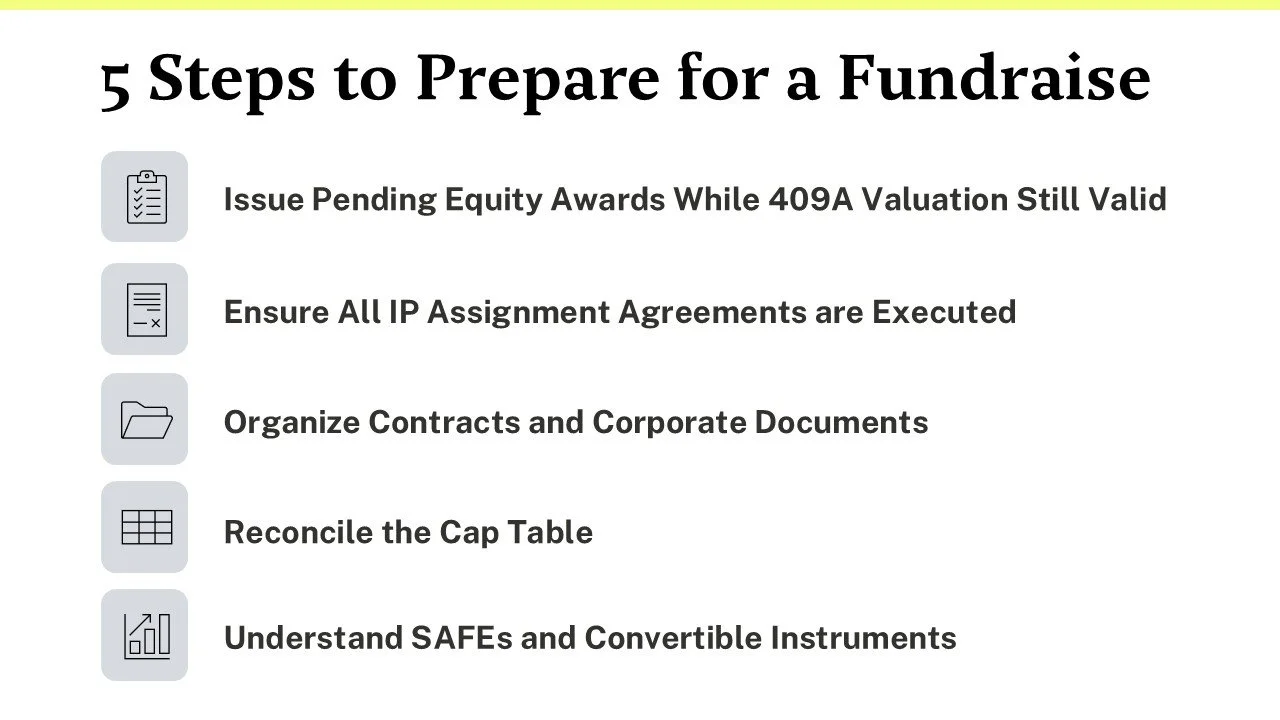
A successful fundraise depends not only on the story a company tells investors, but also on the legal and operational foundation behind it. Here's how sophisticated founders set themselves up for success before the term sheet arrives.
Why Preparation Matters
In venture capital, timing is everything. The period between signing a term sheet and closing a round typically spans 30 to 60 days, but legal and administrative issues can extend this timeline significantly. Once a company has signed a term sheet, its leverage shifts. Investors have committed, but the company is racing against exclusivity periods and market conditions. Issues that surface during diligence can slow things down, erode investor confidence, or, in extreme cases, kill deals entirely. By handling critical legal and administrative tasks before entering active fundraising discussions, a company can compress diligence timelines, maintain negotiating leverage, and signal operational maturity to investors.
Five Critical Preparation Steps
1. Issue Pending Equity Grants Before Receiving a Term Sheet
Under IRS Section 409A, all stock option grants must have an exercise price equal to or greater than the fair market value of the underlying stock. For early-stage companies, this valuation typically comes from a 409A valuation report.
The moment a company receives a term sheet for a priced financing round, the existing 409A valuation becomes stale. Investors are offering to pay a specific price per share, which establishes a new fair market value benchmark. This means the company likely needs to obtain a fresh 409A valuation before granting any additional options, and that new valuation won't be available until after the financing closes.
Options granted post-financing will have a strike price that reflects the new, higher valuation. For employees receiving those grants, this means less upside potential and less attractive equity compensation.
Before entering serious fundraising conversations, companies should review any pending option grants and have the Board of Directors approve those grants while the current 409A valuation remains valid. This ensures the company can attract and retain talent with competitively priced equity throughout the fundraising process.
2. Ensure All IP Assignment Agreements Are Signed
One of the first questions investor counsel will ask is whether the company owns all of its intellectual property. This includes code, designs, inventions, and other IP created by founders, employees, contractors, and advisors.
Ownership is typically established through Confidential Information and Invention Assignment Agreements (CIIAA) or Proprietary Information and Inventions Agreements (PIIAA). These agreements ensure that any IP created in the course of work for the company is automatically assigned to the company.
It's remarkably common for startups to discover during diligence that they're missing signed agreements from early contractors, advisors, or even co-founders. Chasing down these signatures while investors are waiting creates unnecessary stress and delays.
Companies can get ahead of this by reviewing their records for every person who has ever contributed to the product or technology (founders, employees, contractors, advisors, interns, etc.), identifying any missing signatures, and obtaining them as quickly as possible. If someone is unreachable or unwilling to sign, consult with counsel about remediation strategies before investors discover the gap.
3. Organize Contracts and Corporate Documents
Investors will request extensive documentation to verify the company's legal standing, contractual obligations, and corporate governance. While specific requests vary, expect to provide:
Material customer and vendor contracts: Agreements that represent significant revenue or expenses, plus any contracts with unusual terms
Board resolutions and consents: Particularly those authorizing equity issuances, option grants, and major corporate actions
Complete capitalization table: Showing all equity holders, option grants, warrants, and convertible instruments
Employment and service provider documentation: Offer letters, employment agreements, contractor agreements, and advisor agreements
Prior financing documents: SAFEs, convertible notes, warrants, and any previous equity financing documents
Rather than scrambling when the diligence request arrives, it’s advisable to create a virtual data room structure in advance. A standard NVCA diligence request list can be used as your organizational template. Organize documents by category, ensure everything is current and complete, and identify any gaps that need to be addressed. When a company gathers and organizes these documents in advance, there is time to track down missing items without pressure.
4. Reconcile the Capitalization Table
A company's capitalization table is the definitive record of who owns what. Investors will scrutinize it carefully, and any discrepancies between the cap table software (like Carta), corporate records, and actual stock certificates can raise serious red flags. Common discrepancies include:
Option exercises that were completed but not recorded in cap table software
Grants that appear in board minutes but not in the cap table (or vice versa)
Vesting schedules that don't match between systems
Missing or incomplete stock purchase agreements
Cap table discrepancies can fundamentally undermine investor confidence. If there is uncertainty as to who exactly owns the company, investors may question whether they can trust the company's other representations.
Conduct a full reconciliation between the company's cap table software and its corporate records. Review every equity issuance, option grant, and exercise. Resolve any discrepancies and ensure the cap table accurately reflects all board authorizations and executed agreements.
5. Understand Outstanding SAFEs and Convertible Instruments
If a company has raised capital through SAFEs (Simple Agreements for Future Equity) or convertible notes, these instruments typically convert automatically into equity at the closing of a priced financing round. This conversion creates dilution in addition to the dilution from the new money coming in.
Many founders are surprised by the dilution impact when SAFEs convert. Depending on the valuation cap, discount rate, and amount raised, SAFE conversion can significantly affect the fully diluted ownership structure post-closing.
The Board of Directors and management team need to understand the complete picture before terms are finalized with investors. Surprises about dilution after a term sheet is signed create unnecessary friction and can damage relationships.
If there are outstanding SAFEs or convertible notes, model their conversion under various financing scenarios. Understand how different valuation levels will affect dilution. Share this analysis with the Board and key stakeholders so everyone enters fundraising conversations with clear expectations about post-closing ownership.
The Preparation Payoff
Fundraising preparation isn't glamorous, but it's one of the highest-leverage activities a founder can undertake. When diligence requests arrive and you can respond within hours instead of weeks, you accomplish several things simultaneously:
Faster close: Compressed timelines reduce execution risk and get capital in the bank sooner.
Stronger position: By avoiding diligence issues, you maintain negotiating leverage throughout the process.
Professional signal: Operational maturity and attention to detail give investors confidence in your ability to execute.
If your company is looking to take a broader review of its legal and corporate housekeeping, check out our companion post, “Why Start-Ups Should Conduct a Corporate Audit,” which includes an 8-point corporate audit checklist covering many of the issues that commonly arise during financing diligence.
Preparation Checklist
✓ Review and execute any pending option grants before term sheet discussions
✓ Audit all employees, contractors, and advisors for signed IP assignment agreements
✓ Assemble corporate documents and material contracts in an organized virtual data room
✓ Reconcile cap table across all systems and resolve discrepancies
✓ Model outstanding SAFE/convertible note conversion and dilution impact
✓ Brief board and management on preparation status and potential issues