
Insights
Decoding the YC SAFE: A Term-by-Term Guide
This post provides a term-by-term breakdown of the Y Combinator SAFE, explaining how each key provision works in practice. It is designed to help both founders and investors understand the economic mechanics embedded in the instrument so they can make informed decisions about dilution, ownership, and cap table management during early-stage fundraising.
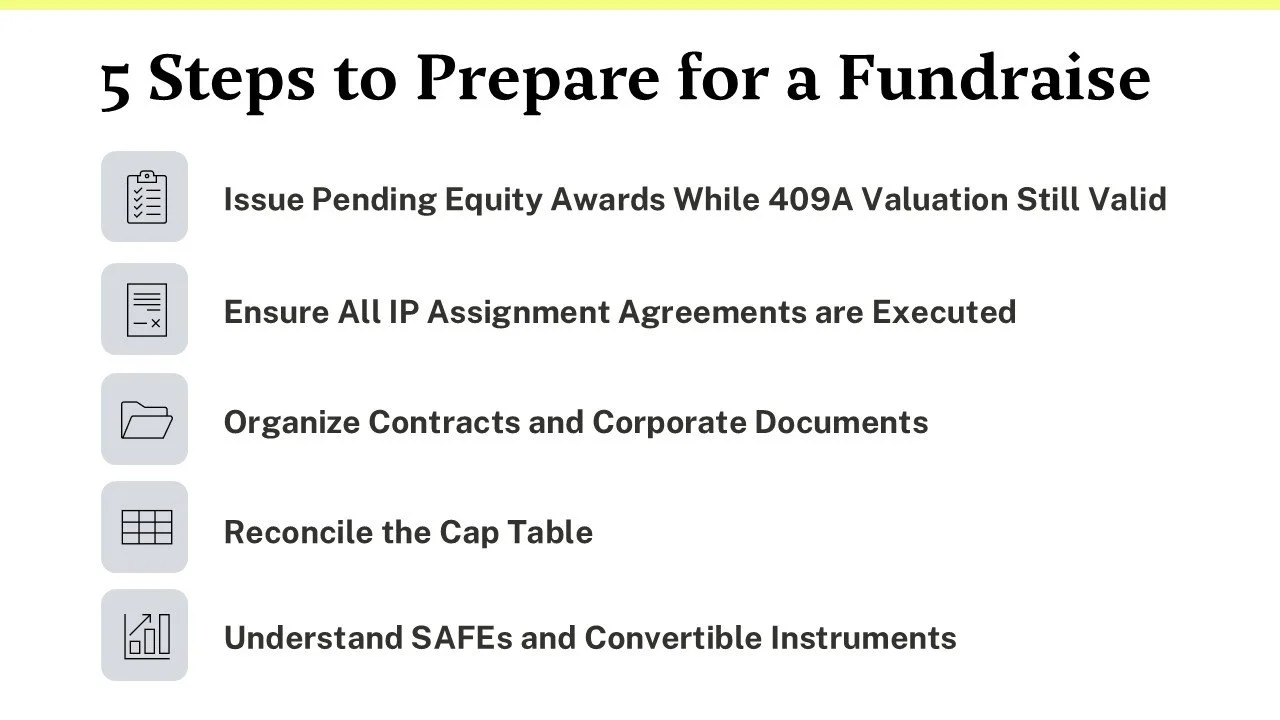
Founder’s Guide to Fundraising Readiness
In this post, we break down five critical legal and operational steps founders should take before launching a fundraise, from cleaning up cap table issues and organizing diligence materials to addressing outstanding equity grants, IP assignments, and SAFE conversion dynamics.

The Case For (and Against) Forming an LLC
The advice to form a Delaware C-Corp is almost universal in startup circles, but entity structure should serve the business, not the other way around. For certain founders, an LLC offers superior tax treatment, greater flexibility, and lower administrative burden.

Basics of Founder Compensation (Part III): Top-Up Grants
This guide breaks down an important tool in the founder compensation playbook: top-up equity grants. We explore when top-ups make sense, how to minimize tax impact, and what documentation is required to get it right.
Decoding the NVCA Term Sheet (Part II): How Governance Provisions Allocate Control
This post is Part II of a two-part series decoding the “NVCA” term sheet. Here, we focus on the key governance terms, including board composition, investor vetoes, information rights, and rights in an exit.
Decoding the NVCA Term Sheet (Part I): Understanding the Economics
This post is Part I of a two-part series decoding the “NVCA” term sheet. Here, we focus on the economic terms that determine ownership, dilution, and exit proceeds.

Flipping to Delaware: What Non-U.S. Founders Need to Know
This post walks through what a Delaware flip actually involves, why U.S. investors often require it, and where complexity tends to arise in practice. We also cover timing considerations, key tax and compliance issues founders should understand, and what comes next once the restructuring is complete.
The New Standard for Investor-Side Legal Representation in VC Financings
Instead of replacing lawyers in venture financings, AI is transforming legal work by eliminating inefficiencies so experienced counsel can deliver faster, better, and more cost-effective outcomes that meet investors’ fiduciary and regulatory obligations.

Stock Options Decoded: Equity Compensation Fundamentals
In this post, we dive into the fundamentals of stock options: how stock options are granted, how vesting schedules work, what acceleration means, the difference between ISOs and NSOs, how strike prices are determined, what it means to early exercise, and what happens to options upon termination.
Basics of Founder Compensation (Part II): Secondary Liquidity
In the second installment of our Founder Compensation Series, we break down the modern liquidity tools that allow founders to responsibly monetize a portion of their equity before an IPO or acquisition, without undermining company or investor alignment.